An on-request check for cost, deployment and docs
This reviewer checks a plan for what the specialist reviewers skip: cost guesses with no source, deployments nobody else could run, and docs that do not match the code. TLM Forge never starts it on its own. You run it by asking for it by name.
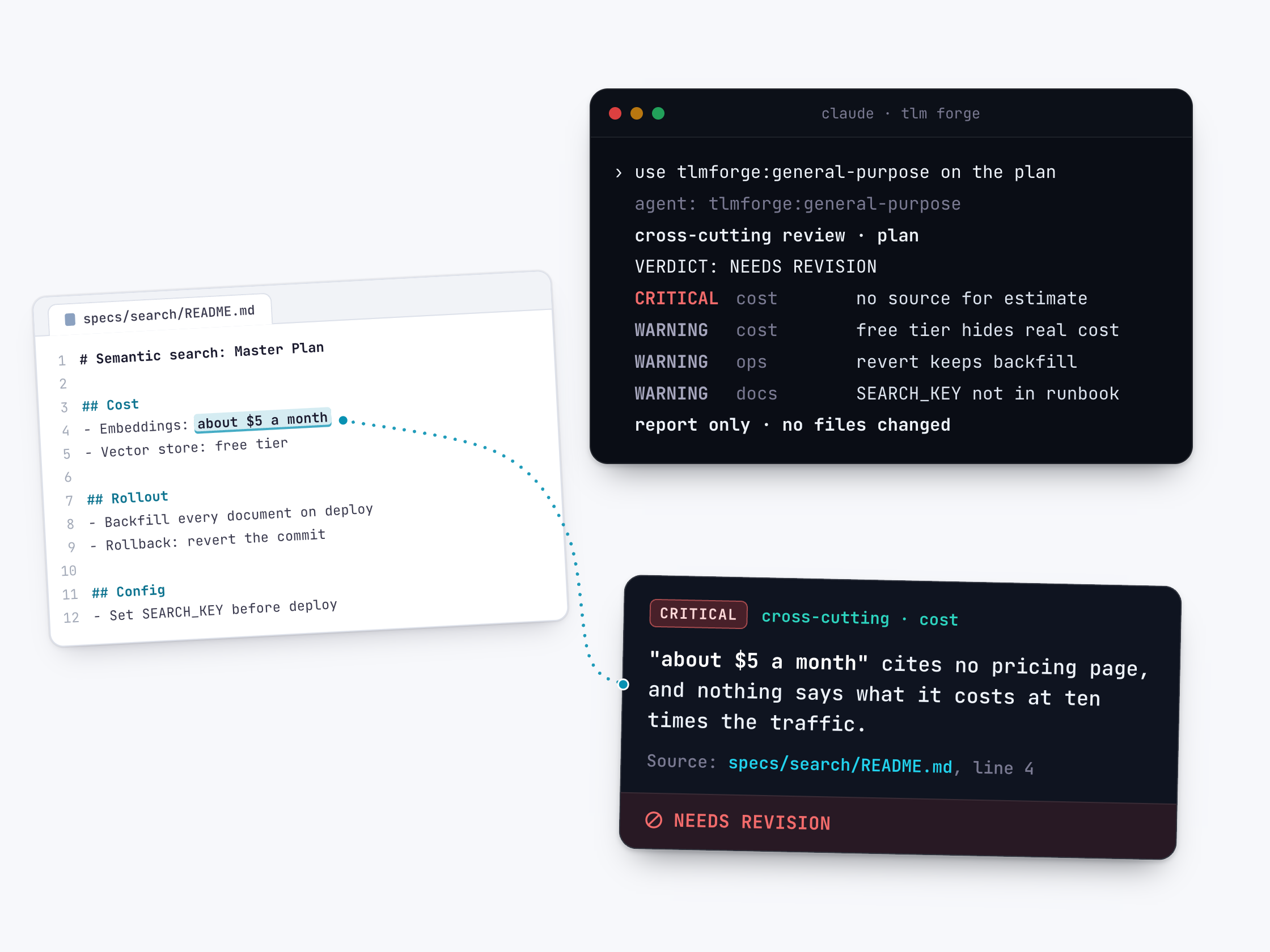
How to use it
Ask Claude in plain English, for example:
use tlmforge:general-purpose to review this plan for cost, ops and docs
It comes with the TLM Forge plugin under the name tlmforge:general-purpose, but /tlmforge:build never starts it, at any level. To run it, ask Claude for it by that full name and point it at a plan or spec that makes real claims about cost, deployment or docs.
Words you will see on this page
- tlmforge:general-purpose
- The exact name to ask for. Plain "general-purpose" is a different agent built into Claude Code.
- Plan or spec
- The written description of what will be built and how.
- Runbook
- Written steps for running a service and fixing it when it breaks.
- Rollback
- Undoing a release to get back to the last working version.
- Cost cliff
- A point where usage grows a little but the bill grows a lot.
- Feature flag
- A switch that turns a feature on or off without a new release.
What it looks for
| What it looks for | An example of what it catches |
|---|---|
| Cost estimates with no source | "About $5 a month" for embeddings, with no pricing page cited. |
| Cost cliffs | A free tier hides the real bill, or ten times the usage costs a hundred times as much. |
| Deploys nobody else could run | A secret the deploy needs is not written down in the runbook. |
| Rollbacks that do not fully undo | Reverting the commit leaves a backfilled index in place. |
| Docs that do not match the code | A README says "just run X", but X needs a step it never mentions. |
| Parts that must change together | An API response changes shape, but one caller is not updated. |
| Missing safety switches | No monitoring and no feature flag on the new code path. |
| Third-party risk | A library with no pinned version and no fallback if the service goes down. |
When it runs
| Level | What the task is | Does this reviewer run? |
|---|---|---|
| Light | A tiny change you can read in ten seconds, like a typo, a rename or a config value | No. Claude makes the change directly, test first, with no review agents. |
| Medium | Fixing or improving something that already exists, with nothing new for users | No. Plan review uses the architect and tester (plus the ux-reviewer if the change has a user interface). |
| Deep | Something new (a feature, screen, endpoint or integration), or anything that changes how the system makes security decisions | No. It is not part of the plan review or the final review. |
| On request | You ask Claude for tlmforge:general-purpose by name | Yes, on the plan or spec you point it at. |
What it does
Each specialist reviewer has its own focus: design, failure cases, code patterns or security. None is built to ask whether a cost estimate came from a real pricing page, whether the secrets a deploy needs are written down, or whether the README's install command works. This reviewer fills that gap. Its instructions describe a practical generalist asking: will this work in production at 3am on a Tuesday?
It checks six areas. Cost: is each estimate backed by real pricing, and could ten times the usage cost a hundred times as much? Deployment: are config and secrets written down, with a runbook and a rollback that works? Docs: do they match the code? Connected parts: are all callers updated together? Readiness: monitoring, alerts and a feature flag. Third parties: pinned versions, licenses, upkeep and a fallback.
It is strict about one thing: a cost estimate with no source is flagged as CRITICAL, and pricing and library facts are checked with web search, not memory. It can read, search and run commands, but it has no file-editing tool, and its job is to report, not to change your files. Its verdict is APPROVE, NEEDS REVISION or DO_NOT_SHIP.
How it works, step by step
You ask for it by name
Point Claude at a plan or spec and ask for tlmforge:general-purpose. It starts fresh, with no memory of the session that wrote the plan.
It lists every claim that could be wrong
Costs, libraries, deployment steps and statements in the docs.
It checks each claim
Costs against current pricing pages, libraries against real versions and APIs, deploy steps by tracing them, and docs against the code.
It writes a report
A verdict, then sections for cost, deployment, docs, connected parts, readiness, must-fix issues and warnings.
You decide what changes
It changes no files. You or Claude update the plan from its findings.
What it looks like
Part of a report. It flags a cost guess with no source, a rollback that would not fully undo the change, and missing monitoring. The headings are the real format; the content is made up for illustration.
## VERDICT: NEEDS REVISION
## Cost Analysis
- Estimate accuracy: Unverified
- "about $5 a month" for embeddings cites no pricing page; no figure at 10x traffic
## Deployment & Ops
- Rollback feasibility: No
- Reverting the commit leaves the backfilled index in place
## Operational Readiness
- Monitoring: Missing
- Feature flag: Missing
Why it is better
Covers what no one else owns
Without it, cost, runbooks and doc accuracy fall between the other reviewers. With it, one reviewer is defined by exactly those gaps.
Numbers get checked
Without it, a plan's cost estimate is often taken on trust. With it, an estimate with no source is flagged CRITICAL and checked against current pricing.
A report, not a rewrite
Without limits, a reviewer might edit your plan for you. This one has no file-editing tool and is told to report, so what to change stays your call.
Good to know
- /tlmforge:build never starts it, at any level. If you want it, ask for it.
- Use the full name, tlmforge:general-purpose. Plain "general-purpose" is Claude Code's built-in agent, which TLM Forge uses to write code. It is not this reviewer.
- It skips code style, test coverage, architecture patterns, UX and security; other reviewers cover those.
- Its cost checks rely on web search at the time of the review. Treat its figures as a reason to cite a source, not as a price quote.
- Inside a /tlmforge:build run on the TLM Forge Pro plan, a check built into the plugin blocks starting any agent, this one included, until you have seen the design drawings and replied. Outside a run, that check does not apply.