Checks big and risky changes harder than small ones
Before any work starts, TLM Forge sorts your task into one of three levels: Light, Medium or Deep. Small, safe changes stay fast, while new features and anything that changes how your code makes a security decision get the full set of checks. You can move the level up or down with one phrase.
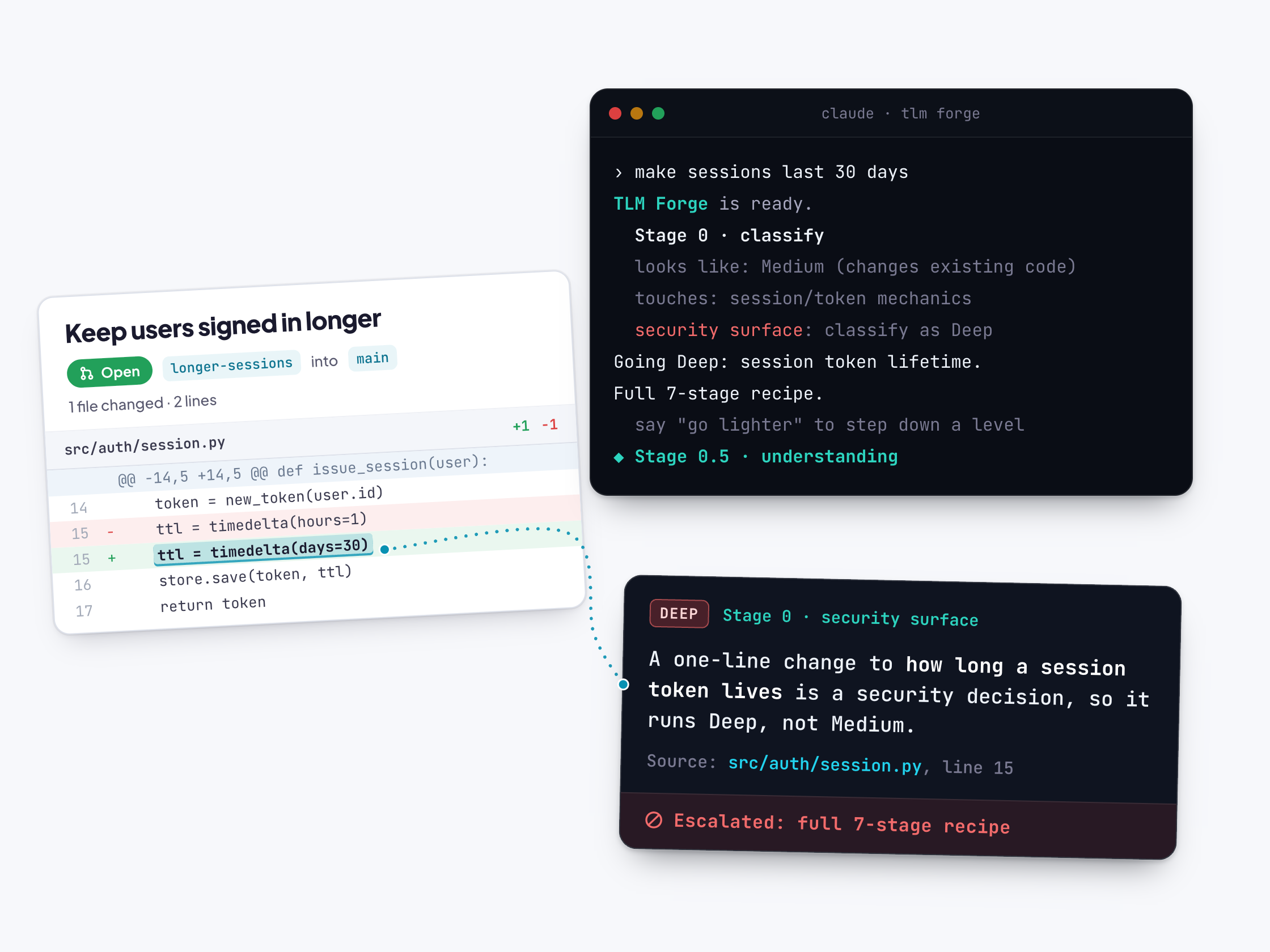
How to use it
/tlmforge:buildThis happens on its own as the first step of every /tlmforge:build request. You do not call it. If you disagree with the level it picks, type "go deeper" or "go lighter" in plain English.
Words you will see on this page
- Light, Medium, Deep
- The three levels of checking, from a quick fix with no extra reviewers up to the full process with at least five reviewers at the end.
- Review agent
- A separate AI helper that reads the plan or the finished code with fresh eyes and reports problems.
- Security decision
- Code that decides who can log in, who can see what, or how passwords, keys and personal data are handled.
- Stage 0
- The very first step of a TLM Forge run, where the level is chosen.
- "go deeper" / "go lighter"
- Phrases you type in plain English to move the task one level up or down.
- Pro
- The paid TLM Forge plan, which adds some extra tools such as the debugging path.
Light vs Medium vs Deep
| At a glance | Light | Medium | Deep |
|---|---|---|---|
| What kind of change | Tiny, with no new logic. You can read the whole change in ten seconds. | Fixes or improves something that already exists. Nothing new for your users. | Adds something new, or changes how your code makes a security decision. |
| Everyday example | Fix a typo, rename something, change a config value. | Fix a bug in an existing export, clean up a module, add missing tests. | A new feature, endpoint, screen, integration or login flow. Also a one-line change to how long a login lasts. |
| What TLM Forge does | Claude makes the change itself: writes a test first, then checks its own work. | A short written analysis of the fix, a written fix plan, a review of that plan, a tests-first build, then a final review. | The full process: a full risk check, a plan reviewed for security threats, a tests-first build, a final review, and a live check on a real environment. |
| How much review | No review agents. | Two agents review the plan and two review the finished code, three each if it changes the user interface. | Three agents review the plan and five review the finished code, one more each if it changes the user interface. |
| Stops for your OK on the design | No. The design drawings are printed and work continues. | Yes. | Yes. |
The security rule: these always go Deep, however small
| Area | In plain words |
|---|---|
| Login flow logic | How a user proves who they are. |
| Secrets and credentials | Passwords, API keys and other secret values. |
| Personal data access | Who is allowed to see personal information. |
| Cryptography | Encryption and related math that keeps data safe. |
| Sessions and tokens | How long a login lasts and how login tokens work. |
| Access control | Who is allowed to do what in your app. |
What it does
A typo fix and a new payment flow should not get the same process. A full review on a rename wastes your time. A quick pass on a login change is how security bugs ship. So TLM Forge asks one question first: are you changing something that already exists, or adding something new? Fixing or improving existing code is Medium. Adding something new is Deep. A tiny change with no new logic is Light.
Size alone does not decide it. If a change touches how your code makes a security decision, it goes Deep even if it is one line. Changing how long a login session lasts is a good example. That means the full process, including a reviewer who looks at the plan for security threats and another who attacks the finished code like a hacker would.
TLM Forge tells you the level in one sentence and starts right away, without asking you to confirm. You stay in charge: say "go deeper" or "go lighter" to move it one level. If the task turns out bigger than expected while Claude is working, TLM Forge tells Claude to pause, say so, and continue at the higher level.
How it works, step by step
Skip anything that is not a code change
Questions and read-only requests are just answered, with no process at all. On Pro, a "why is this broken?" request goes to a separate debugging path.
Ask: changing or adding?
Fixing or improving what exists points to Medium. Adding something new points to Deep. A tiny change with no new logic is Light.
Apply the security rule
Anything that changes a security decision goes Deep, whatever its size.
Announce and start
Claude names the level and the reason in one sentence and starts working. On Medium and Deep it also lists which review agents will run.
Adjust when you ask
Say "go deeper" or "go lighter" and Claude moves one level and announces again. Going from Medium to Light means Claude just makes the change directly.
Step up if the task grows
If a security issue or a bigger scope appears mid-task, Claude pauses, tells you, and continues at the higher level.
What it looks like
What you see in your terminal: two requests, the level TLM Forge picked for each, and you asking for more checking on the second one. Wording follows the plugin's real format; the requests are made up.
> /tlmforge:build make sessions last 30 days instead of 1 hour
Going Deep: changes session token lifetime, a security surface.
Full 7-stage recipe.

> /tlmforge:build fix the CSV export dropping the last row
Going Medium: fixes an existing export path. Abbreviated spec audit,
fix plan, single-round review, build, one review wave, one fix wave,
proof pack.
> go deeper
Going Deep: re-classified one level up at your request.
Full 7-stage recipe.
Why it is better
Small changes to sensitive code get real checking
Without TLM Forge, an AI judges risk by how big a change looks. With it, a two-line login change gets the same depth of review as a brand new login flow.
Tiny fixes stay fast
Without a sizing step, every change gets the same process: too heavy for a typo, or too light for a login change. With it, Light work runs no review agents and skips the planning steps, so a typo fix is just a test and the change.
You can overrule it with one phrase
Without TLM Forge, you manage the process yourself. With it, there is no confirmation prompt to slow you down, and "go deeper" or "go lighter" changes the level at any point.
You see the cost before it starts
Without TLM Forge, you find out how heavy a run was afterwards. With it, Medium and Deep runs list their review agents up front, before any of them start.
Good to know
- Claude picks the level by following TLM Forge's written rule, not by running a script. If it picks wrong, "go deeper" or "go lighter" fixes it.
- Payments are not on the security list by themselves. A payment change that touches stored credentials or who can access what is.
- Light work still writes a test first, still restates your request, and still prints the design drawings. It just does not stop for your approval or use review agents.
- Going from Medium to Light leaves the full process. Claude then makes the change directly.