You stay in control of every run
TLM Forge makes the calls, but you can change them in plain words. Say "go deeper" or "go lighter" to change how much process runs, approve or correct the design when it is shown, say "pause for review" to stop and read findings, or use an override to get past a check.
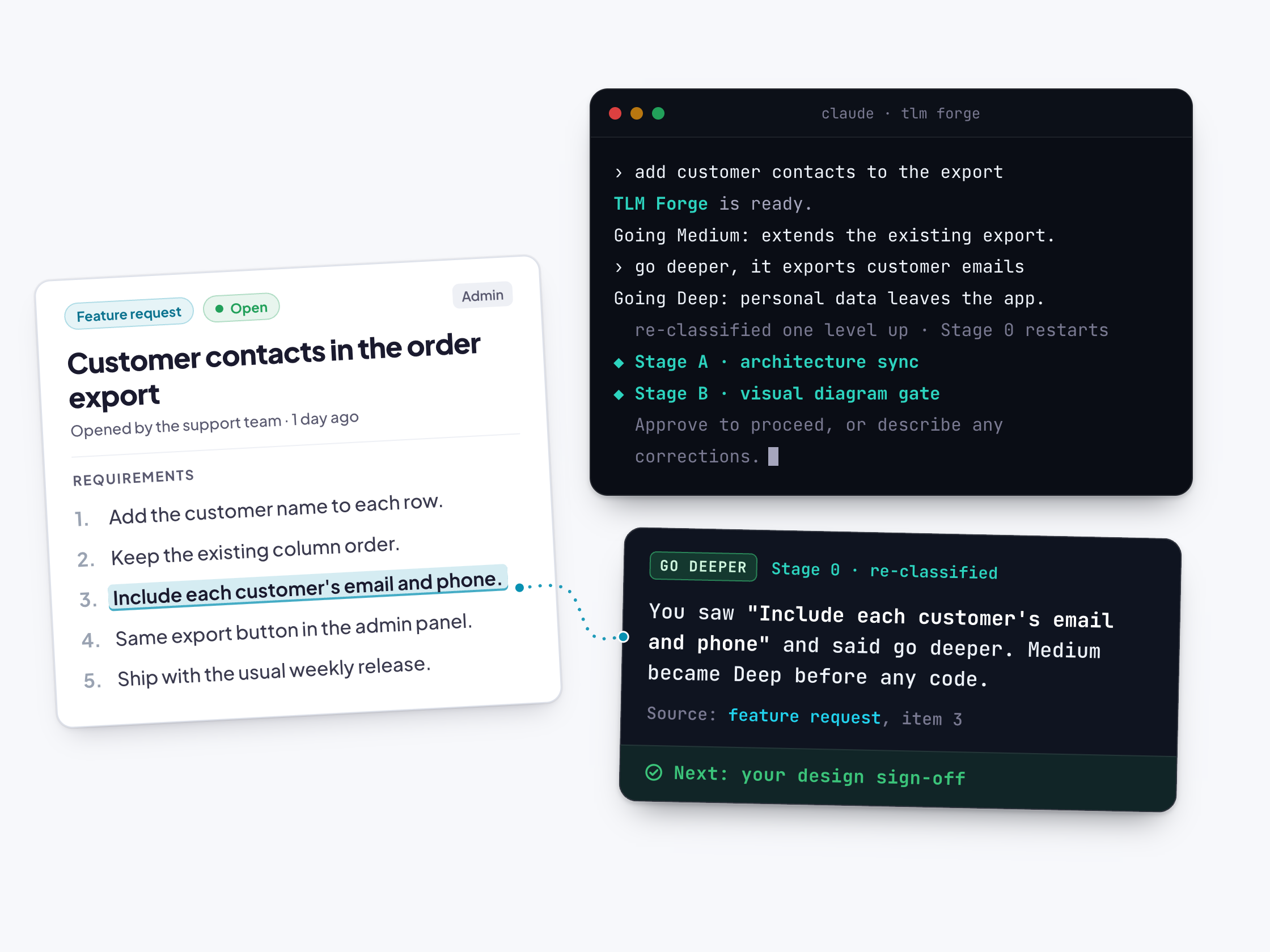
How to use it
Ask Claude in plain English, for example:
go deepergo lighterpause for reviewresumejust do it
These work during any /tlmforge:build run. "Go deeper" and "go lighter" work at any level. "Pause for review" and the design approval apply on Medium and Deep work, where review agents run. An override phrase covers one message, and TLMFORGE_HOOKS=0 turns the built-in checks off for the whole session.
Words you will see on this page
- Light, Medium, Deep
- How much process TLM Forge runs: Light is a tiny change Claude makes directly, Medium fixes or improves what exists, Deep adds something new or touches a security decision.
- Design gate
- The point where TLM Forge shows you diagrams of the planned change and asks if they match what you want.
- Hook
- A small check built into the plugin that runs before Claude acts and can stop the action.
- Findings (CRITICAL, HIGH, MEDIUM, LOW)
- Problems the review agents report, ranked by how serious they are.
- Commit lock
- A built-in check that stops a commit if the code changed after the final review, until the new code is reviewed.
- Pro
- TLM Forge's Pro plan. On Pro, a built-in check also enforces the wait at the design gate. The commit lock is on for everyone.
What you say or set, and what it does
| What you say or set | What it does | When |
|---|---|---|
| "go deeper" | Moves the task up one level and starts the run again from the first step | Any time, any level |
| "go lighter" | Moves the task down one level. From Medium to Light, Claude leaves the full process and makes the change directly, with tests and a self-check | Any time, any level |
| Your reply to the design diagrams | Approves the design, or tells Claude what to change so it redraws the diagrams and asks again | Medium and Deep, at the design gate |
| "pause for review" | Claude finishes its current edit, waits for every reviewer, and reports open findings by severity | Medium and Deep, while building |
| "resume" | Carries on from the next phase | After a pause |
| Asking for another review round | Runs one more round. TLM Forge never starts a third round on its own | End of a build |
| "just do it", "be quick" or "trivial fix" in a message | Lets that one message past the built-in checks | Any time |
| TLMFORGE_HOOKS=0, set before starting Claude Code | Turns the built-in checks off for the whole session | Whole session |
Instruction or built-in check?
| Control | How it is enforced |
|---|---|
| "go deeper" and "go lighter" | TLM Forge tells Claude to do it |
| "pause for review" and "resume" | TLM Forge tells Claude to do it |
| Waiting at the design gate | On Pro, a built-in check blocks subagent launches and code edits until there is an entry from you after the design |
| No commits on unreviewed code (commit lock) | On Pro, a built-in check |
What it does
Every /tlmforge:build run starts by sorting your task into Light, Medium or Deep and telling you in one sentence, without asking first. If it guessed wrong, you fix it in two words. "Go deeper" moves up one level and restarts the run's first step. "Go lighter" moves down one level. You can say either at any point, not only at the start.
On Medium and Deep work, the run stops at the design gate. It shows a flowchart and a sequence diagram and asks if they match what you want. You approve, or describe changes and get new diagrams. On Pro, a built-in check holds this stop: subagent launches and edits outside the design folders (specs/ and docs/) are blocked until there is an entry from you after the design.
While work runs, "pause for review" makes Claude finish its current edit, wait for every reviewer, and report what they found. "Resume" carries on. If a check blocks you, an override phrase in your message or TLMFORGE_HOOKS=0 gets you through. At the end, the hard calls are yours: a CRITICAL problem that cannot be fixed comes to you to decide.
How it works, step by step
Correct the level
After the one-line "Going Medium" or "Going Deep" note, say "go deeper" or "go lighter". The run announces the new level and starts again from the first step.
Answer at the design gate
On Medium and Deep, reply to approve the diagrams or describe what to change. Claude redraws them and asks again.
Pause and read
Say "pause for review" to get a report of open findings by severity. Say "resume" to continue from the next phase.
Ask for more review if you want it
TLM Forge stops after two review rounds and never starts a third on its own. You can ask for another.
Decide what is left
A CRITICAL problem the fixes cannot solve comes to you: fix it, accept it with a written reason, or abandon. On Pro, accepting leftover findings is recorded in your own words, only after you say so.
Get past a check when you must
Add "just do it", "be quick" or "trivial fix" to a message, or set TLMFORGE_HOOKS=0 before starting Claude Code.
What it looks like
Top: what you see after saying "pause for review" (invented values). Bottom: a built-in check's block message, which ends by naming a way past it.
> pause for review
Paused at Phase 2 after commit 4e1a9c2. Open notifications:
0 CRITICAL, 1 HIGH, 2 MEDIUM/LOW. Review
specs/order-export/notifications.md, then say 'resume' to continue.

[tlmforge] The design has not been shown yet.
...
To proceed anyway: set TLMFORGE_HOOKS=0, or include 'just do it' in your message.
Why it is better
Two words, not a rewrite
Without TLM Forge, changing how careful the AI is means rewriting your request and hoping it lands differently. With it, you say "go deeper" or "go lighter".
A stop that actually waits
Without it, a plain prompt can print a plan and carry straight on. With it, on Pro, a built-in check blocks subagent launches and code edits until there is an entry from you after the design.
Never locked out
Without an escape, a strict check could trap you. With it, every block message names a way through, and both ways come from you: a phrase in your own message, or a setting made before Claude Code starts.
You own the trade-offs
Without it, the agent decides what is good enough. With it, unfixable CRITICAL problems come to you, extra review rounds happen when you ask, and accepted risk is recorded in your words.
Good to know
- Override phrases must be in your message: "be quick", "just do it" or "trivial fix", in any capitals. The bare words "minimal" or "trivial" do not count, because they show up too often in normal technical text.
- A phrase covers only the message it is in. TLMFORGE_HOOKS=0 (or false, no, off) covers the whole session; set it in your shell before starting Claude Code.
- "Go deeper", "go lighter" and the pause are instructions TLM Forge gives Claude, not built-in checks. The design gate wait and the commit lock are built-in checks on Pro.
- At each stage, TLM Forge sends its server only the stage name. Set TLMFORGE_STAGE_PINGS=0 to stop these; license-load events are still recorded on the server.
- Every run also tells you what it understood before writing any spec or code, and stops for your answer when an open question would change the approach.