Run only the tests your change can affect
Claude maps which Python files import which, then lists only the test files your change can reach. During a build, TLM Forge tells Claude to run just those while it works, and every test at the end. You can also ask for the list any time.
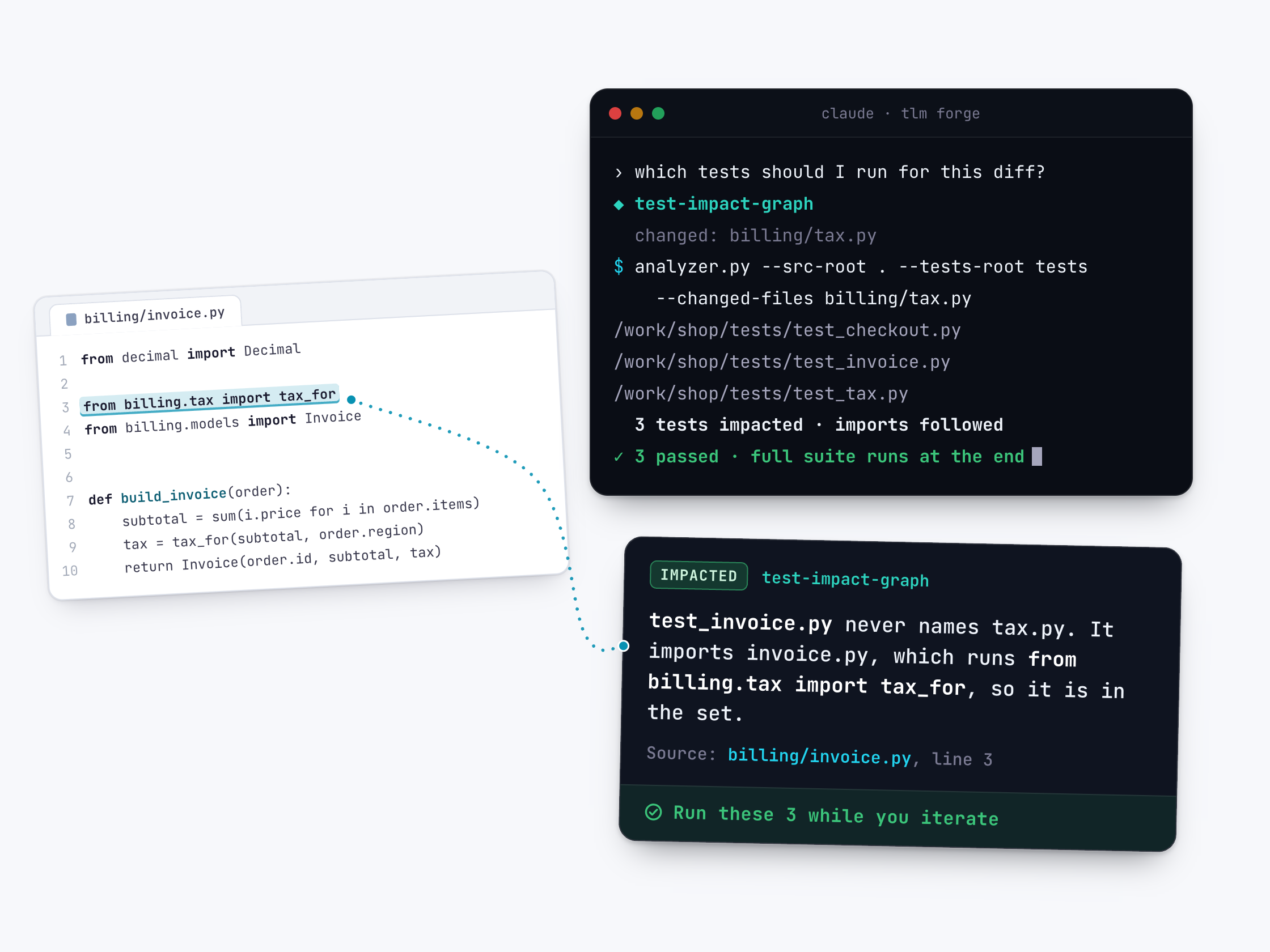
How to use it
Ask Claude in plain English, for example:
which tests should I run after this diff?test impact for this diffskip tests that don't matter
Ask in plain English at any time. During a /tlmforge:build run on Medium or Deep work, TLM Forge also tells Claude to use it while building and while fixing review findings: only the affected tests while iterating, then the full suite once at the end of the build and again before the final review (Stage 5).
Words you will see on this page
- Test suite
- All the tests in your project.
- Import graph
- A map of which files import which other files.
- Impacted tests
- Test files that import your changed file, directly or through a chain of other files.
- conftest.py and fixtures
- Shared test setup files that many tests use, so a change there can affect every test.
- Static analysis
- Reading the code without running it.
- Final review (Stage 5)
- The review TLM Forge runs on the finished change.
Three ways to pick tests after a change
| Approach | Speed | What it misses |
|---|---|---|
| Run the whole suite after every edit | Slow | Nothing, but you wait every time |
| Pick tests by file name | Fast | Tests that reach your change through another file |
| The test impact list | Fast | Runtime imports, relative imports and config files loaded at runtime |
When you get a short list, and when to run everything
| What changed | What happens |
|---|---|
| A normal Python source file | You get the test files that import it, directly or indirectly |
| conftest.py or a file in a fixtures folder | No list, just a note recommending the full suite |
| Security code (auth, encryption, payments) | Claude is told to run the full suite anyway |
| A bigger change that maps to only one to three tests | Claude is told to do one full run before merging |
| A deleted file | Skipped with a warning, so run the full suite |
| A third-party package upgrade | Not visible to the tool, so run the full suite |
What it does
Running every test after each small edit is slow. Guessing which few to run misses things. The test impact graph replaces the guess with a fact: which test files import the code you changed, either directly or through a chain of other files. It is a small Python script that Claude runs for you, with nothing extra to install.
The script reads every Python file in your source and test folders without running them. It notes each import, then works backwards from your changed files to every file that depends on them. It keeps only the test files and prints their full paths, one per line, ready to pass to pytest.
It plays safe where it cannot see. If a shared test setup file (conftest.py or a fixtures folder) changed, it gives no list and recommends the full suite, since those affect every test. Claude is also told to run the full suite for security-related changes, and to do one full run before merging when a bigger change maps to only one to three tests.
How it works, step by step
Read every Python file
The script collects all .py files in your source and test folders and reads their import lines. A file it cannot parse adds nothing.
Build the map
Each import becomes a link between two files. The map is then reversed, so it can answer "who depends on this file?"
Walk out from your change
Starting at the files you changed, it follows the links to every file that depends on them, directly or indirectly.
Keep only tests
It keeps files in the tests folder, or with test_ in the name, or ending in _test.py, and prints their paths.
Run those, then everything
During a build, TLM Forge tells Claude to run the listed tests while it works, then the full suite once at the end of the build and again before the final review.
What it looks like
Two sample runs (invented paths). First, a change to billing/tax.py lists the three test files that reach it. Second, a change to the shared test setup file gives no list and recommends the full suite.
$ python3 analyzer.py --src-root . --tests-root tests \
    --changed-files billing/tax.py
/work/shop/tests/test_checkout.py
/work/shop/tests/test_invoice.py
/work/shop/tests/test_tax.py

$ python3 analyzer.py --src-root . --tests-root tests \
    --changed-files tests/conftest.py
# conftest.py or fixtures changed, recommend running full suite
Why it is better
Facts, not guesses
Without TLM Forge, picking tests by file name misses tests that reach your change through another file. With it, the script follows real imports, so those tests are included.
Fast while working, complete at the end
Without it, you choose between waiting on every test and hoping you picked the right few. With it, Claude is told to run the affected tests while working and the full suite at the end of the build.
Safe where it cannot see
Without it, a shared setup change can slip by on a partial run. With it, a conftest or fixture change gets no shortcut list, only a recommendation to run everything.
Ready to use
Without it, you build the test list by hand. With it, the output is one path per line, ready for pytest or a pre-push script.
Good to know
- Python only. JavaScript, end-to-end UI tests and other languages need their own approach.
- It reads code without running it, so it cannot see imports made at runtime (such as importlib.import_module) or config, YAML or JSON files loaded at runtime. Keep an always-run list of tests for those.
- Relative imports (from .tax import x, or from . import tax) are not followed, so tests reached only that way are missed. If your project uses relative imports, run the full suite before merging.
- Run the full suite after a package upgrade or when a change deletes a file. The script cannot see upgrades, and it skips deleted files with a warning.
- It lists test files, not single test functions, and it does not show the import chain behind each one.